
UK Storm Names: How a Decade of Labeling Storms Has Revolutionized Public Safety

It began with Abigail. A decade ago, the first officially named storm in UK history swept across the northwestern Scottish coast, unleashing gusts of 84 mph (135 km/h) and marking a pivotal shift in how the nation communicates weather threats. This week marks ten years since Storm Abigail inaugurated a new era of meteorological awareness. What started as an experiment has become an indispensable public safety tool, transforming abstract weather forecasts into memorable, trackable events that people can understand, discuss, and, most importantly, prepare for. In the years since Abigail, the Met Office, in collaboration with its Irish (Met Éireann) and Dutch (KNMI) counterparts, has named a total of 70 storms. This system has done more than just assign labels; it has fundamentally changed the relationship between the British public and the severe weather that batters its shores. This deep dive explores the profound impact of the UK storm names system, from its life-saving rationale to the quirky process of choosing names and a look back at the most destructive systems to have earned a title.
The “Why”: The Critical Public Safety Rationale Behind Naming Storms
Before the advent of the UK storm names system, the most infamous weather events were often identified by the date they struck. The Great Storm of 1987, the Burns’ Day Storm of 1990, the St. Jude’s Day Storm of October 2013—these names were retrospective, coined after the damage was done. This presented a clear problem for proactive public safety: how do you effectively warn people about a complex, evolving threat that doesn’t yet have a simple, memorable identity?
The answer was to give it one. Naming a storm before it makes landfall has proven to be a masterstroke in risk communication. A name transforms a vague forecast of “a deep area of low pressure” into a specific, trackable entity—Storm Eunice or Storm Jocelyn. This specificity is crucial for driving public engagement. Will Lang, the Met Office’s Chief Meteorologist, encapsulates it perfectly: “A storm name is more than a label, it’s a public safety tool that makes severe weather easier to remember, talk about and follow.”
The strategy is backed by tangible results. When Storm Flores hit in August 2025, a remarkable 93% of people living in the Amber Alert warning area were aware of the impending danger. This high level of awareness is a direct outcome of a system that cuts through the noise, ensuring that vital warnings are seen, understood, and acted upon.
UK Storm Names
When Does a Storm Get a Name? The Science of Selection
The naming of a storm is not an arbitrary decision. It is a calculated step taken by the UK’s National Severe Weather Warning Service based on a careful assessment of anticipated impacts. The decision hinges on two key factors:
- The potential for damage and disruption caused by the weather.
- The likelihood of those impacts occurring.
Typically, a storm is named when its effects are expected to trigger an Amber or, in rare cases, a Red weather warning. While the primary driver is often wind strength, other impacts like significant rainfall or snow are also considered. For instance, Storm Babet in October 2023 and Storm Dennis in 2020 were notable more for their torrential rain and flooding than for wind alone. In fact, Storm Desmond in 2015 set the record for the highest daily rainfall from any named UK storm at 267mm.
A Decade in Review: The Most Notable Named Storms
The past ten years have provided a stark demonstration of nature’s power, with several storms leaving an indelible mark on the national consciousness.
- Storm Eunice (2022): A landmark event for which two rare Red weather warnings were issued. Part of a trio of named storms in a single week (along with Dudley and Franklin), Eunice was the most severe storm to hit England and Wales since February 2014, causing widespread structural damage and travel chaos.
- Storm Éowyn (January 2025): This storm stood out as the most powerful windstorm in over a decade, prompting a Red warning for Northern Ireland and parts of Scotland. Its impact underscored the system’s value; named three days before landfall, it allowed media and authorities to build a coherent and highly effective public awareness campaign.
- Storm Jocelyn (January 2024): A prime example of the international collaboration at the heart of the system. Named by Met Éireann due to its severe impact on the Republic of Ireland, it retained its name as it moved across to the UK, demonstrating seamless cross-border communication.
The Quirky World of Choosing “UK Storm Names”
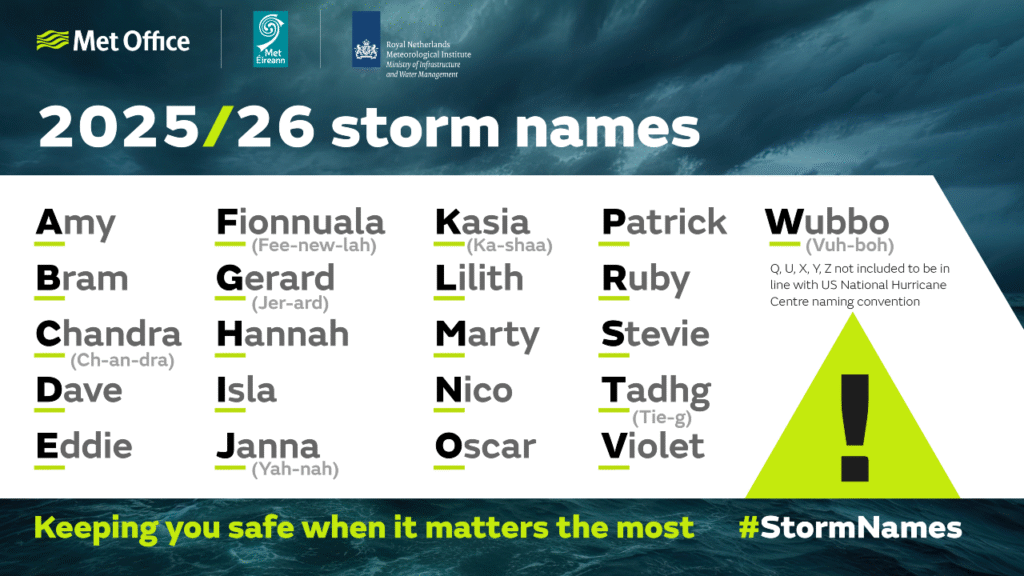
Each September, a new list of names for the coming season is released, reflecting the unique, collaborative nature of the project. The lists run from A to W, following the convention of the US National Hurricane Center, and omit the letters Q, U, X, Y, and Z.
What makes the UK storm names particularly charming is their source. The names are proposed by the three partner meteorological services and, crucially, by the public. This results in a wonderfully diverse and sometimes whimsical set of choices that reflect the cultures of the UK, Ireland, and the Netherlands.
- Literary and Cultural Nods: “Bram” honors Bram Stoker, the author of Dracula.
- Public Submissions with Personality: “Dave” was suggested by a member of the public “to celebrate my husband who snores three times louder than any storm.”
- Personal Tributes: “Ruby” was named after a beloved grandmother and was the most popular public suggestion for the ‘R’ name in a recent season.
This public involvement does more than just generate interesting names; it fosters a sense of ownership and connection, further enhancing public engagement with the weather. Interestingly, the busiest season to date was 2023/24, which ended with Storm Lilian. Conversely, the quietest was 2022/23, which only saw two named storms, Antony and Betty, right at the season’s end.
The International Dimension: When Storms Keep Their Names
The system is designed to be flexible and recognizes that weather systems are no respecters of national borders. When a storm is named by another meteorological service, the UK partners allow it to keep its original name for consistency. This prevents confusion and ensures a single, clear identity is tracked across international media.
Key examples include:
- Storm Ophelia (2017): A former hurricane that retained its American-given name as it slammed into the UK, bringing powerful winds on the 30th anniversary of the Great Storm of 1987.
- Storm Herminia (January 2025): This storm kept its Spanish name as it moved northward and impacted the UK.
Conclusion: A System That Has More Than Proved Its Worth
A decade on from Storm Abigail, the evidence is overwhelming. The UK storm names system has been a resounding success. It has transformed public safety communication, making warnings more accessible, understandable, and actionable. By giving a face and a name to the tempest, it has empowered a nation to better prepare, respond, and ultimately, stay safer. In a world where the frequency and intensity of severe weather events are a growing concern, this simple yet powerful tool has become an essential part of the UK’s resilience, proving that sometimes, a name can be a lifesaver.
Why did the UK start naming storms?
The UK introduced storm naming ten years ago to improve public safety. Giving a storm a name makes it easier for the media, government agencies, and the public to track, discuss, and prepare for severe weather events, leading to greater awareness and action.
Who decides on the UK storm names?
The lists are collaboratively decided by the UK’s Met Office, Ireland’s Met Éireann, and the Netherlands’ KNMI. The public is also invited to submit suggestions, which are often included in the final lists.
What triggers a storm to be named?
A UK Storm Names is named when it is expected to cause impacts severe enough to trigger an Amber or Red weather warning from the National Severe Weather Warning Service. This is based on the potential for damage and disruption and the likelihood of it happening.
What was the most powerful named storm in the last decade?
Storm Éowyn in January 2025 is considered one of the most powerful in the last decade, being the strongest windstorm in over ten years and prompting a Red weather warning.
Do storms from other countries keep their names when they hit the UK?
Yes. To avoid confusion, storms that have been named by other international meteorological services, such as ex-hurricanes or storms named by Spanish meteorologists, retain their original names when they affect theUK Storm Names.
Table of Contents
Read More News UK Storm Names









[…] More News Gaza Aid […]
[…] Read More News […]