
Remembrance Sunday Scotland: A Nation Falls Silent in Solemn Tribute to its War Dead

There is a particular, profound silence that descends upon Scotland every year on the second Sunday of November. It is not an empty silence, but a heavy, resonant one—a silence filled with memory, gratitude, and collective grief. This past Remembrance Sunday Scotland was no different. Across the country, from the grand squares of its cities to the quiet corners of its villages, people paused to honor the men and women who gave their lives in the two World Wars and subsequent conflicts. The air grows still, the bustling traffic halts, and for two full minutes, a nation collectively holds its breath. This year’s commemorations, centered in Edinburgh and Glasgow, were not just about ritual; they were a powerful, living bridge connecting generations, ensuring that the stories of immense sacrifice are not lost to time but are carried forward with reverence and understanding. This is a deep dive into the ceremonies, the symbolism, and the heartfelt personal stories that defined Remembrance Sunday Scotland, painting a portrait of a nation forever shaped by its past and determined to never forget.
The Heart of the Commemoration: Edinburgh’s Solemn Ceremony
The national focal point for Remembrance Sunday Scotland was at the heart of its capital. At the City Chambers in Edinburgh, a somber and dignified ceremony unfolded. First Minister John Swinney led the nation’s tributes, standing alongside Presiding Officer Alison Johnstone, Scottish Secretary Douglas Alexander, Edinburgh’s Lord Provost Robert Aldridge, and rows of veterans and serving military members.
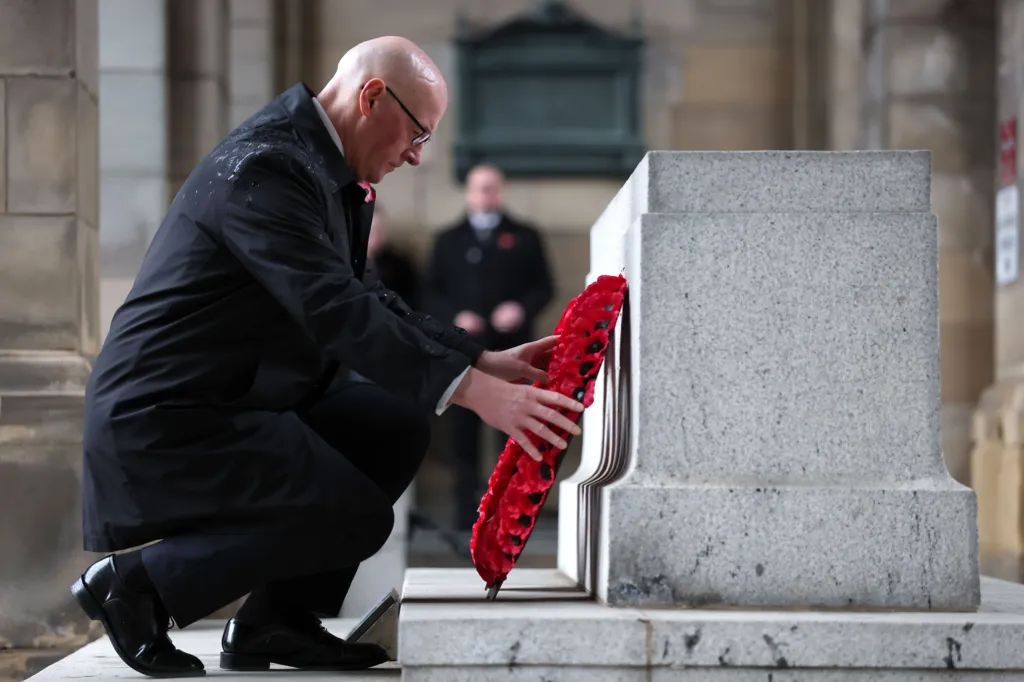
At precisely 11:00 GMT, following the tradition observed across the United Kingdom, a two-minute silence was observed. This silence is the cornerstone of the day—a universal, unspoken language of respect. It marks the moment the Armistice ended the First World War in 1918, and in that quiet, the weight of history is palpable. After the silence, Mr. Swinney laid a wreath of red poppies against the stone of the war memorial at the entrance of the City Chambers. The red poppy, inspired by the famous poem “In Flanders Fields,” has become a global symbol of remembrance, its vivid color a stark reminder of the blood spilled in the fields of battle.
A Leader’s Reflection: Connecting Past Sacrifices to Present Challenges
Speaking after the ceremony, First Minister Swinney provided a poignant reflection that connected the sacrifices of the past with the realities of the present. He emphasized that understanding these sacrifices is crucial for all generations, especially as Edinburgh’s service involved a significant number of young people.
“I always think about those who lost their lives, those who made sacrifices for our freedom and our liberty today,” he told the BBC. “It is very important that we pause to reflect on all the challenges we face in the world today and remember the sacrifices that were made by others to ensure that we could live in peace and freedom and security, and that we never take that for granted.”
His words underscored that Remembrance Sunday Scotland is not merely a historical exercise. It is a vital moment of national introspection, a time to consider the cost of the peace and freedoms enjoyed today and a reminder of the ongoing duty to protect those values in a complex and often troubled world.
The Personal Stories: Keeping Memory Alive for a New Generation
Beyond the official ceremonies, the true soul of Remembrance Sunday Scotland resides in the personal stories of families for whom the wars are not just chapters in a history book, but intimate family history.
James Mitchell: A Young Man’s Mission
Twenty-seven-year-old James Mitchell attended the Edinburgh ceremony wearing medals belonging to various members of his family who served in both World Wars. He represented a powerful and hopeful trend: the deep engagement of younger generations. He revealed that he has nearly 40 relatives who served in British forces, many of whom did not survive.
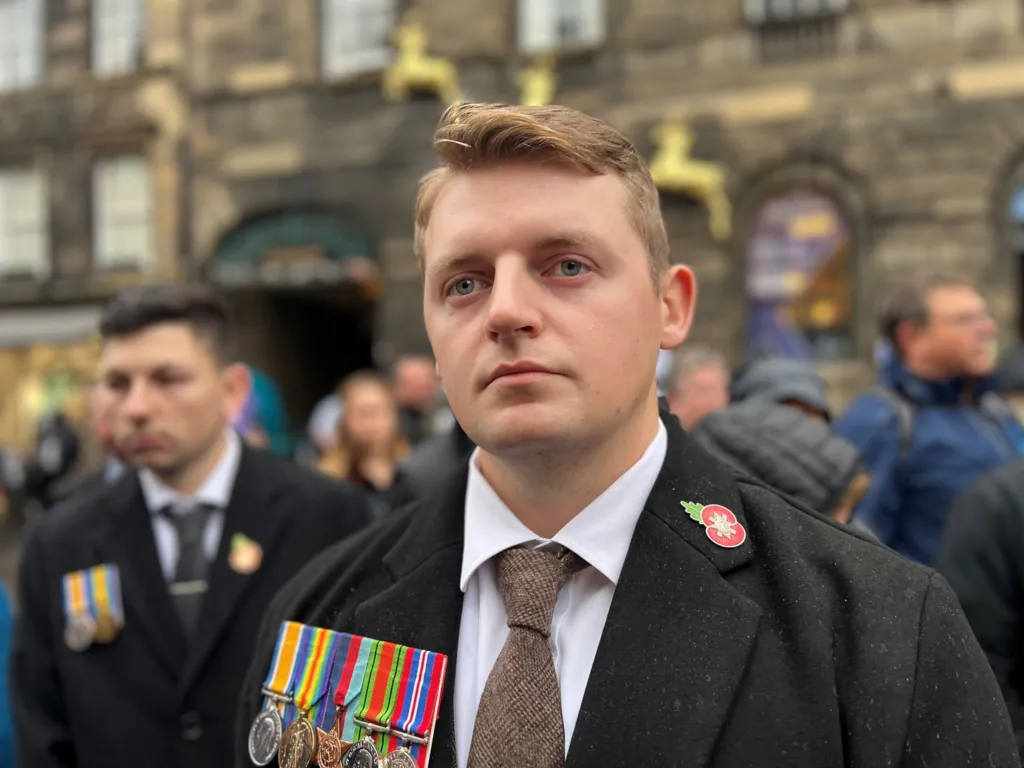
His great-grandfather was wounded during the evacuation of Dunkirk but survived. His five sons also served, one of whom was captured by Japanese forces in Hong Kong. “That alone is a horrific story and the brutality that was faced in the treatment of those people is why we need to make sure these stories carry on,” James stated. “I think it’s so important to keep their memory alive, especially in this day and age because so many of the memories and the stories are forgotten.”
James expressed a belief that his generation should look to older generations for inspiration, rather than to modern “so-called” influencers. “I’m only 27. Me and my friends… we are the youngest here by far voluntarily and it’s a shame because some of the stories you hear are incredibly inspiring.” His presence is a testament to the enduring power of family legacy and a conscious effort to ensure the torch of remembrance is passed on.
Bill Watson: An Australian Veteran’s Tribute
The commemorations also attracted those from across the Commonwealth, whose histories are inextricably linked with Britain’s. Australian Bill Watson, who spent 35 years in the Royal Australian Air Force, came with his own deep military lineage. His father served in both World Wars, and Bill wore a medal belonging to his grandfather, who fought in the Battle of the Somme for 24 hours straight—one of the deadliest battles in human history, with over one million casualties in July 1916 alone.
“I feel at this stage that I probably owe it to my father and my grandfather to think about them occasionally,” Bill said simply. His words capture the quiet, personal sense of duty that drives people to remember, a feeling that transcends nationality and binds them in a shared understanding of loss and valor.
Glasgow’s Service: A Message of Dignity and Hope
In Glasgow, the usual wreath-laying ceremony at the Cenotaph on George Square was moved to the Glasgow Cathedral this year due to construction work. Military personnel, veterans, and bands paraded briefly before the service, which was led by Rev Dr Mark Johnstone.
The sermon delivered was profoundly moving, shifting the focus from purely historical remembrance to a broader, more inclusive message of human dignity applicable to today’s world. Rev Johnstone spoke not just of the fallen soldier, but also of the refugee, the child in the Middle East, the mother on the edge of Europe, and the teacher in Africa.
“It is not just tolerance or inclusion – it is the recognition that every human life bears the image of God,” he declared. He called for the bells of the cathedral to not only echo with the past but to call the city toward a future worthy of the name. “As these bells ring, let us make a Glasgow where dignity is not a privilege, but a right. Where peace is not the absence of war, but the presence of compassion.” This powerful reframing connected the ultimate sacrifice of soldiers with the ongoing global struggle for peace and human dignity, making Remembrance Sunday Scotland a relevant and urgent call to action.
The Scale of Sacrifice: Remembering the Numbers
The personal stories are set against a backdrop of almost unimaginable scale. An estimated 3 million military personnel and labourers from the Commonwealth served with Allied forces in the First World War. In the Second World War, that number grew to a further 4.5 million. Each one of these numbers was a person like James Mitchell’s great-grandfather or Bill Watson’s grandfather, with a life, a family, and a story. Remembrance Sunday Scotland is, at its core, about restoring the humanity behind these staggering statistics.
What is Remembrance Sunday in Scotland?
Remembrance Sunday is a national day of commemoration observed on the second Sunday of November each year to honor the members of the armed forces and civilians who have died in the two World Wars and later conflicts. Remembrance Sunday Scotland
What happens during the two-minute silence?
At 11:00 AM on Remembrance Sunday, the nation observes a two-minute silence. This marks the exact time the armistice ended the fighting in World War I in 1918. It is a universal sign of respect and a time for personal reflection.
Why is the poppy the symbol of remembrance?
The red poppy was inspired by the poem “In Flanders Fields,” which described how poppies grew on the battlefields of World War I. It was adopted as a symbol of remembrance and hope, and wearing one is a way to show respect and support for the armed forces community.
Who leads the main Remembrance Sunday ceremony in Scotland?
The national ceremony is typically held at the City Chambers in Edinburgh and is led by the First Minister of Scotland, alongside other senior political figures, military representatives, and veterans.Remembrance Sunday Scotland
How are younger generations getting involved in remembrance?
As seen with individuals like James Mitchell, many young people are actively participating by attending ceremonies, researching family military history, and wearing their ancestors’ medals to ensure their stories are not forgotten.
Table of Contents
Read More News Remembrance Sunday Scotland










[…] Read More News […]