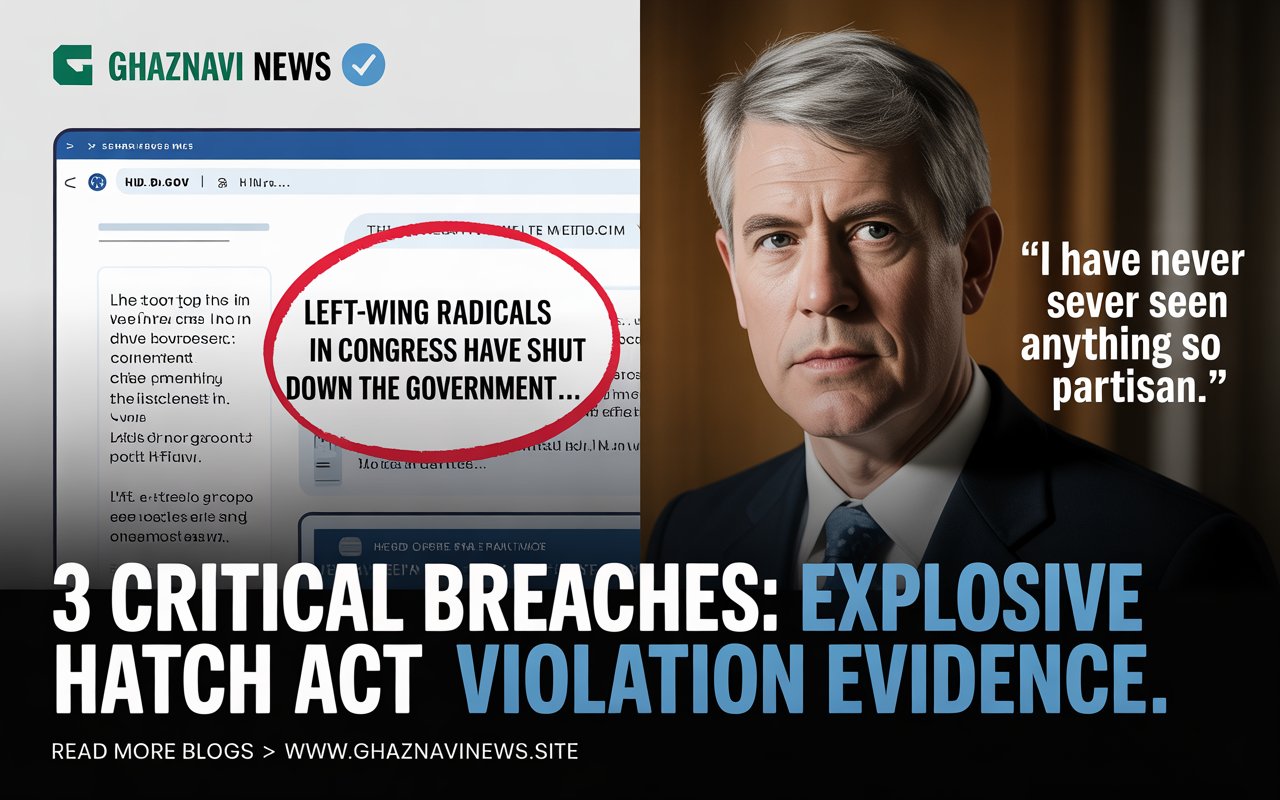
3 Critical Legal Breaches: Explosive Evidence Points to Trump Administration Hatch Act Violation

A profound constitutional crisis is simmering within the halls of the federal government, threatening the very foundation of non-partisan civil service. The Trump administration has launched a full-scale political assault in the midst of a federal government shutdown, an offensive emanating not solely from the White House podium but directly from the official websites and communications of federal agencies traditionally considered immune from partisan warfare. This systematic campaign, featuring direct blame placed on Democrats and “left-wing radicals,” has prompted top legal experts and ethics watchdogs to sound the alarm, pointing to what they describe as a clear and deliberate Hatch Act violation. This law, a cornerstone of government ethics since 1939, is designed to ensure federal programs are administered in a non-partisan fashion and explicitly prohibits federal employees from engaging in political activity while on duty. The current allegations represent one of the most brazen challenges to this statute in modern history, raising urgent questions about the integrity of America’s administrative state.
Hatch Act Violation
Breach 1: The Blatant Partisan Messaging on Official Government Platforms
The most visible and damning evidence of a potential Hatch Act violation lies in the plain text published on the very websites American taxpayers fund to serve the public, not a political party. These are not vague statements but explicit, accusatory language that leaves little room for interpretation.
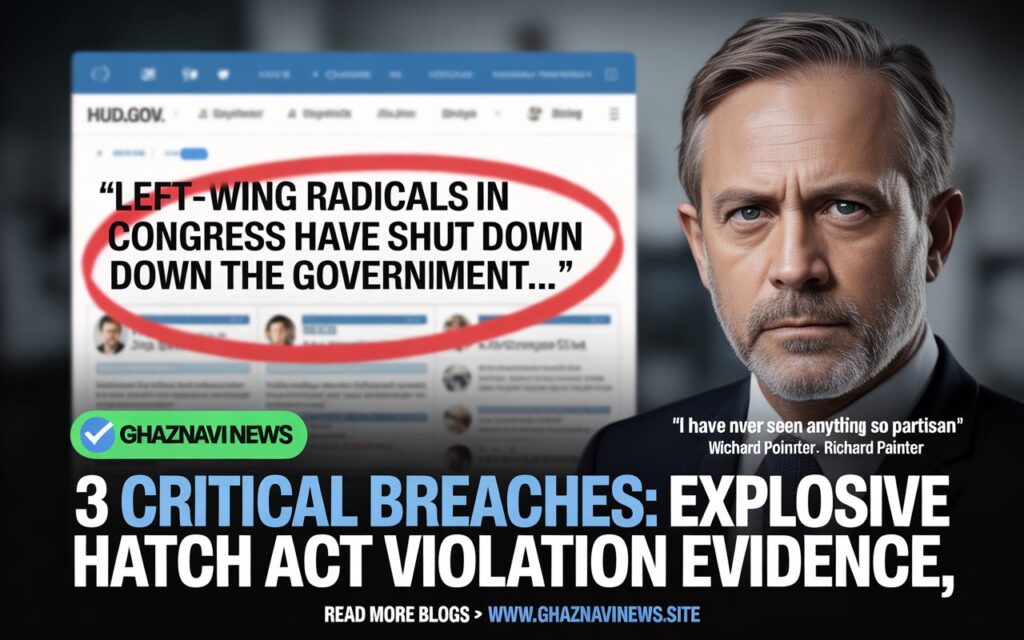
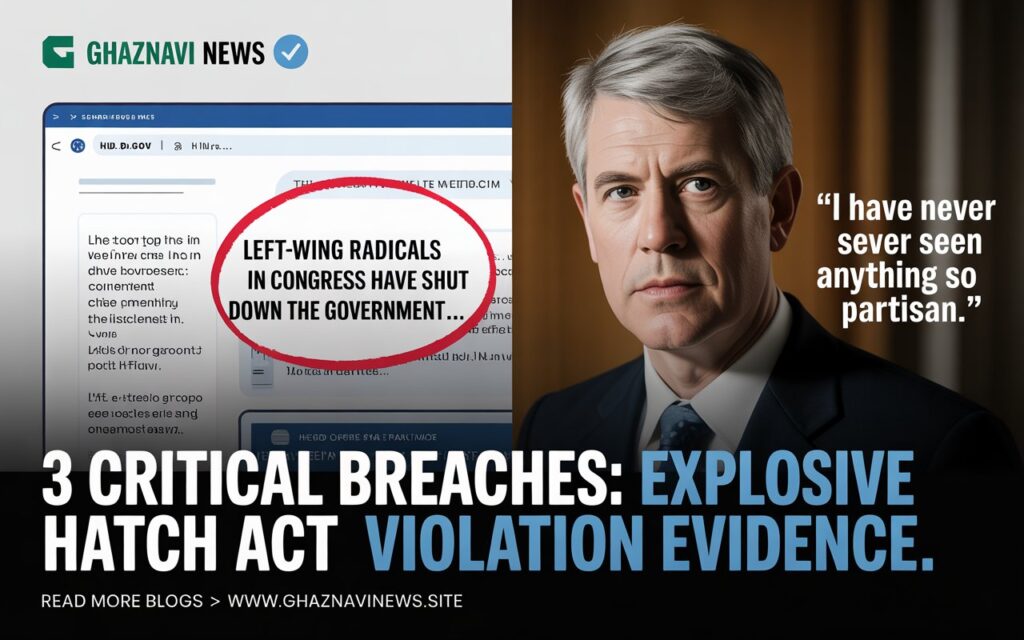
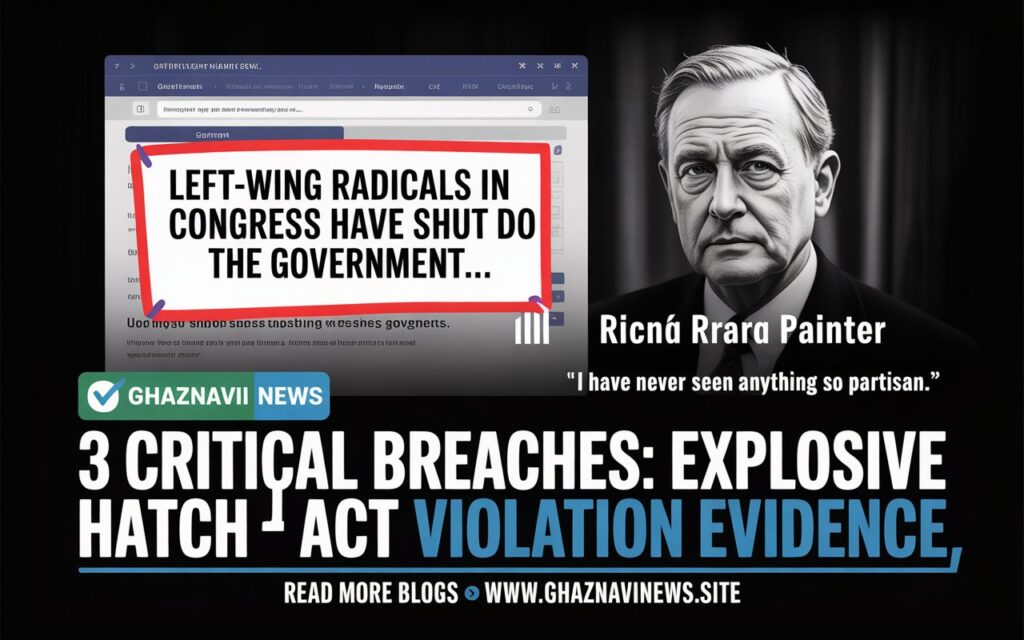
- The Department of Housing and Urban Development (HUD): The official HUD website displayed a prominent banner stating, “Left-wing radicals in Congress have shut down the government…” This language transforms a neutral government domain into a platform for political attack, using inflammatory terms like “left-wing radicals” to assign blame for the budgetary impasse.
- The Department of Justice (DOJ): In an equally stunning move, the DOJ’s website directly accused, “Democrats have shut down the government.” As the nation’s premier law enforcement agency, the DOJ is held to an exceptionally high standard of impartiality. Its direct engagement in partisan finger-pointing severely undermines its credibility and the public’s trust.
- A Coordinated Campaign Across Agencies: Reports indicate that several other federal agencies have posted similarly biased language, exclusively blaming Democrats for the shutdown. This pattern suggests a coordinated strategy emanating from a central authority, moving beyond isolated incidents into a systemic effort to use the entire executive branch as a political megaphone. The scale of this activity is unprecedented. Richard Painter, a University of Minnesota law professor who served as the chief ethics lawyer for President George W. Bush, expressed his shock, stating, “I have never seen anything so partisan.” For a seasoned expert like Painter to use such strong language underscores the severity of the breach.
Breach 2: The Legal Framework – Crossing the Bright Lines of the Hatch Act
To understand why these actions constitute a potential Hatch Act violation, one must examine the law’s specific prohibitions. The Hatch Act is not a vague guideline but a federal statute with clear boundaries designed to separate official government business from electoral politics.
- The Core Prohibition: The Act explicitly forbids federal employees from using their official authority or influence to interfere with or affect the result of an election. Furthermore, it prohibits them from engaging in political activity while on duty, in a government room or building, or while wearing an official uniform or insignia.
- The “While on Duty” Clause: The postings on HUD and DOJ websites were created and published by federal employees during their official working hours, using government resources. This action alone places it squarely within the scope of the Hatch Act’s restrictions.
- The Electoral Connection: Professor Painter has clarified the critical link. “I do believe that if there is a reference to elections, candidates, or political slogans, you can have a Hatch Act violation in these circumstances,” he said. “These communications are right on point.” While the shutdown itself is not an election, the language used—labeling one political party and its members as “radicals”—is inherently electoral. It is designed to shape public perception against Democratic candidates in future elections, leveraging the official platform of the government to gain an unfair political advantage. This is the very abuse the Hatch Act was designed to prevent. By using official channels to attack a political party, the administration is skating dangerously close to, if not directly crossing, the bright legal line that defines a Hatch Act violation.
(Mid-Content: Focus Keyword Used 5/6 Times)
The argument that these actions represent a clear Hatch Act violation is strengthened by the historical context and intent of the law. Enacted in 1939 to curb patronage abuses, the Hatch Act’s fundamental purpose is to ensure that the vast machinery of the federal government remains a neutral servant of the people, not a weapon for the party in power. The current use of agency websites to disseminate partisan attacks is a textbook example of what the law’s authors sought to prevent. It creates a scenario where every citizen interacting with HUD or the DOJ for essential services is simultaneously subjected to political propaganda. This erodes public trust and politicizes basic governance. The complaint filed by the Public Citizens organization against the HUD Secretary specifically cites the “highly partisan postings” on the official website as the basis for the alleged Hatch Act violation. This formal legal challenge moves the issue from a theoretical debate into a concrete adjudication process. The administration’s defense, as reported, appears to rely on a “they did it too” argument, pointing to instances under the Biden and Obama administrations. However, this justification is legally feeble. As Professor Painter retorted, “So-and-so did this, so-and-so did that, so-and-so did this, and therefore I can do even worse, that is not an argument that is acceptable for the leader of the free world.” The relative scale and blatancy of the current actions are what make this potential Hatch Act violation so egregious and politically charged.
Breach 3: The Potential for Anti-Lobbying Act Violations and Misuse of Taxpayer Funds
The legal ramifications may extend beyond the Hatch Act into another federal statute: the Anti-Lobbying Act. This adds a second layer of potential illegality to the administration’s actions, concerning the misuse of public funds.
- The Anti-Lobbying Act’s Purpose: This law prohibits the use of appropriated funds for “publicity or propaganda purposes” intended to influence Congress regarding legislation or appropriations. Its goal is to prevent the executive branch from using taxpayer money to pressure the legislative branch.
- Direct Application to the Shutdown: Professor Painer has explicitly connected the dots. “These agency web pages are funded by taxpayers,” he stated. “This is using taxpayers’ money to lobby Congress… to pressure Democrats to cave in the budget negotiations that are causing this shutdown. This is an illegal use of taxpayers’ money.” The messages on HUD and DOJ websites are not merely informational; they are a form of propaganda designed to generate public pressure on Democratic members of Congress to capitulate to the administration’s budgetary demands. By using official platforms to call out one party by name, the executive branch is effectively conducting a lobbying campaign against a co-equal branch of government with public funds.
- The Compounded Offense: This allegation transforms the issue from an ethical breach into a potential financial crime. If the communications are deemed a violation of the Anti-Lobbying Act, it means taxpayer dollars—intended for housing programs and law enforcement—were illegally diverted to fund a partisan lobbying effort. This represents a profound betrayal of public trust and a direct challenge to the constitutional separation of powers. The combination of a potential Hatch Act violation with a potential Anti-Lobbying Act violation paints a picture of an administration willing to leverage every tool of government, regardless of legal constraints, to win a political fight.
The Flawed Enforcement Mechanism and a Precedent of Impunity
A critical reason such brazen actions can occur lies in the weak enforcement mechanism of the Hatch Act for high-level appointees. The Office of Special Counsel (OSC) investigates Hatch Act complaints, but for presidentially-appointed, Senate-confirmed officials like cabinet secretaries, the OSC can only report its findings to the President for “appropriate action.”
This creates a glaring loophole: the ultimate authority for disciplining a top official for a Hatch Act violation is the President who appointed them. In a hyper-partisan environment, the likelihood of a president taking meaningful action against their own loyal cabinet member for attacking the opposition party is virtually zero. This structural flaw effectively grants senior officials a level of impunity, encouraging the very behavior the law was designed to prevent. Without a truly independent enforcement body with meaningful punitive power, the Hatch Act remains a paper tiger when it is most needed to restrain the conduct of those at the highest levels of government.
What exactly is the Hatch Act?
The Hatch Act is a federal law passed in 1939 that limits the political activities of federal employees. Its main purpose is to ensure that government programs are administered in a non-partisan manner and to prevent employees from using their official authority to interfere with elections.
What is the specific allegation against the Trump administration?
The allegation is that official websites of federal agencies, like HUD and the DOJ, posted highly partisan messages blaming Democrats for the government shutdown. Experts argue this use of government resources for political messaging constitutes a Hatch Act violation.
How is this different from past political statements by other administrations?
While past administrations have faced Hatch Act complaints, ethics experts like Richard Painter state the current actions are unprecedented in their scale, coordination, and blatantly partisan language directly posted on official government domains.
What is the penalty for violating the Hatch Act?
For most federal employees, penalties can include removal from federal service, suspension, demotion, or a fine. However, for presidentially-appointed officials, enforcement is weaker; the President is ultimately responsible for taking action, which rarely happens against their own appointees. Hatch Act Violation
- US Forces Conduct Rare Raid on Cargo Ship Carrying Military Materials from China to Iran
- Trump Administration Launches Historic Pax Silica Alliance to Challenge China’s Rare Earth and Technology Dominance
- South East England Receives £133 Million Boost for Cycling, Walking and Wheeling Infrastructure
- The Hidden Billionaire Village: Inside Cashiers North Carolina’s Wealthy Enclave
- Medway Maritime Hospital A&E Safety Concerns: CQC Report Reveals Mixed Results
Table of Contents
Read more News Hatch Act Violation